


Retrofitting trapezoidal sheet metal insulation: Effort vs. ready-made solutions
Retrofitting insulation to trapezoidal sheet metal is a challenge faced by many owners of older industrial and commercial buildings. Rising energy costs, condensation problems and a lack of thermal comfort often make retrofitting insulation unavoidable. However, insulating existing trapezoidal sheet metal constructions is technically demanding and involves considerable effort.
While subsequent insulation measures are possible in principle, practice shows that the better solution is to use factory-insulated sandwich panels. Anyone building a new building or carrying out extensive renovation work today should utilise the benefits of integrated insulation systems from the outset.
Why insulate trapezoidal sheet metal retrospectively?
Uninsulated trapezoidal sheeting only fulfils one function: protection from the weather. It offers practically no thermal insulation. This leads to various problems:
High energy losses: heat escapes through the roof or walls in winter and heat penetrates in summer. Energy costs increase considerably.
Condensation: Warm indoor air condenses on the cold underside of the trapezoidal sheet metal. Dripping condensation damages goods, machines and furnishings.
Low comfort: Large temperature fluctuations make rooms uncomfortable. Icy in winter, unbearably hot in summer.
Legal requirements: Minimum energy standards apply to major conversions. Subsequent insulation becomes mandatory.
Retrofitting insulation seems to be the logical solution. But practice shows: The effort involved is often underestimated.
Methods for retrofitting insulation to trapezoidal sheet metal
On-roof insulation for trapezoidal sheet metal roofs
On-roof insulation is the most thermally favourable solution. Insulation boards made of mineral wool, EPS or PIR are laid on the existing trapezoidal sheet metal, with new roof waterproofing on top.
Advantages: Minimal thermal bridges, no reduction in room height
Disadvantages: Complete roof structure required, scaffolding costs, weather-dependent, time-consuming
Roof-mounted insulation often requires structural analyses, as the additional weight places a load on the supporting structure.
Under-rafter insulation and internal insulation
Insulation from the inside is more common. A substructure with insulation and internal panelling is installed under the existing trapezoidal sheet metal.
Advantages: No scaffolding costs, weather-independent, existing outer skin remains
Disadvantages: Reduced room height, thermal bridges due to substructure, vapour barrier critical
The airtight bonding of the vapour barrier is crucial. Moisture ingress leads to mould and structural damage.
Insulation between the purlins
In accessible constructions, insulation can be inserted between the purlins. This method combines elements of both variants.
Advantages: Lower costs than on-roof insulation, better insulation values than pure internal insulation
Disadvantages: Thermal bridges through purlins remain, complex vapour barrier routing
Effort and costs of retrofitting insulation
Work steps and time required
Retrofitting insulation involves numerous work steps:
Preparation: Inventory, structural analysis, planning of the insulation levels, authorisations
Execution: Scaffolding, assembly of the substructure, laying the insulation, installation of the vapour barrier with airtight bonding, rear ventilation level, new cladding, detailed work on connections
Time required: Depending on the size of the building, insulation takes several weeks to months. With on-roof insulation, rain stops the work.
The loss of production during the construction period must be taken into account.
Cost factors
Major cost factors: Insulation material, vapour barrier, substructure, wages for several trades, scaffolding for external work, planning and approvals, loss of production.
Retrofit insulation is generally significantly more expensive than factory-insulated panels in new buildings. The reason: multiple works, more complex detailed solutions and the need to work with existing constructions.
Challenges with retrofit trapezoidal sheet insulation
Thermal bridges and airtightness
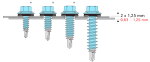
The biggest technical challenge: thermal bridges are difficult to avoid. Every fixing screw, every support, every connection breaks through the insulation layer.
Unavoidable thermal bridges: steel purlins and beams, insulation fixing points, connections to walls and supports, trapezoidal sheet metal overlaps
These thermal bridges significantly reduce the insulation effect. The calculated U-value is often not achieved in practice.
Airtightness: The airtight bonding of the vapour barrier at all connections is extremely complex. Every leak leads to moisture ingress and structural damage.
Vapour barrier and rear ventilation
The vapour barrier prevents moisture diffusion in the insulation. Correct installation is particularly critical when retrofitting insulation.
Problems: Connections to existing trapezoidal sheet metal are difficult to bond, penetrations require special solutions, damage during installation
Rear ventilation: A rear ventilation layer between the insulation and trapezoidal sheet metal is essential. The subsequent creation of sufficient rear ventilation with functioning supply and exhaust air openings is complex.
Errors often only become apparent years later - by which time the damage has already been done.
Achievable U-values
Retrofit insulation typically achieves U-values between 0.20-0.35 W/m²K. The unavoidable thermal bridges reduce the overall U-value by 20-40 %.
Modern sandwich panels achieve U-values of up to 0.11 W/m²K in the factory - without thermal bridges, as the insulation is foamed over the entire surface and without interruption.
When is retrofit insulation worthwhile?
Retrofitting insulation makes sense:
Economically sensible: Building in good condition, useful life still 15-20 years, no comprehensive refurbishment planned, very high energy costs
Technically necessary: Legal requirements for change of use, condensation problems, monument protection
Insulation is NOT worthwhile: If a complete renovation is due anyway, if trapezoidal sheet metal has corrosion damage, in the event of structural defects, in the event of a planned change of use with higher requirements
In these cases, replacement with modern sandwich panels is the better investment.
Ready-made solution: sandwich panels instead of retrofitting insulation
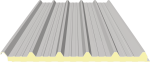
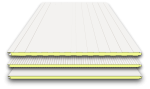
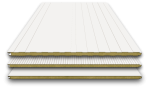
While retrofitting insulation is possible, sandwich panels for roofs and sandwich panels for walls offer the better solution from the outset. They combine cladding, thermal insulation and a vapour barrier in one factory-made building element.
Advantages of integrated insulation
No thermal bridges: The insulating core made of polyurethane (PU) or polyisocyanurate (PIR) is fully foamed with the cover layers. The tongue and groove system prevents linear thermal bridges.
Optimum U-values: U-values of up to 0.11 W/m²K depending on core thickness - guaranteed and without deductions due to thermal bridges.
Factory quality: Insulation installed under controlled conditions, integrated vapour barrier.
Fast installation: One work step replaces several trades. Panels are mounted directly onto the substructure - finished.
Airtightness: Precise tongue and groove system with factory-fitted seals. No need for time-consuming gluing work.
No rear ventilation required: Closed construction prevents moisture ingress. There are no condensation problems.
Maintenance-free: Minimal maintenance required due to closed construction.
Comparison: Retrofit insulation vs. sandwich panels
|
Criterion |
Retrofit insulation |
Sandwich panels |
|
Installation time |
Several weeks |
Few days |
|
Work steps |
6-8 trades |
One work step |
|
Thermal bridges |
Unavoidable |
Minimised |
|
U-value |
0.20-0.35 W/m²K |
up to 0.11 W/m²K |
|
Airtightness |
Elaborate bonding |
System-related tightness |
|
Vapour barrier |
Prone to faults |
Integrated |
|
Rear ventilation |
Complex |
Not applicable |
|
Sources of error |
Many interfaces |
Complete system |
|
Production downtime |
Weeks to months |
Minimal |
|
Maintenance |
Regular |
Maintenance-free |
Sandwich panels are the more economical and technically superior solution for new buildings or extensive refurbishments. Further details in our detailed guide to sandwich panels.
Conclusion: Retrofit insulation or build right away?
It is possible to insulate trapezoidal sheet metal retrospectively, but it is technically demanding and involves considerable effort. Thermal bridges remain, airtightness is difficult to achieve and execution requires the utmost care.
For existing buildings in good condition, retrofitting insulation can make economic sense. However, anyone building a new building or planning a complete refurbishment should opt for factory-insulated sandwich panels from the outset.
The higher material costs are amortised by drastically reduced installation costs, better insulation values and freedom from maintenance. The lower production downtime is an additional advantage.
Our recommendation: Let us advise you individually as to whether retrofit insulation or modern sandwich panels are the better solution for your project. Successful reference projects demonstrate the versatility of modern insulation systems.
Last updated Nov 2025