


Trapezoidal sheet disadvantages: 7 problems and how to avoid them
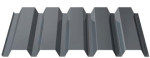
Trapezoidal sheeting is an economical and proven solution for roofs and walls in halls, garages and carports. Its quick installation, low costs and robustness make it a popular choice for many construction projects. However, trapezoidal sheeting also has significant disadvantages that can become a problem depending on how it is used.
This article takes an objective look at the 7 main disadvantages of trapezoidal sheet metal and shows how modern sandwich panels avoid these problems from the outset. This will help you make the right decision for your project.
When are trapezoidal sheet disadvantages relevant?
Not every disadvantage is relevant for every project. The significance depends on the use:
Disadvantages do NOT play a role for:
- Unheated warehouses without staff presence
- Open roofs and carports
- Temporary buildings with a short service life
- Projects with a minimal budget
Disadvantages become a PROBLEM for
- Heated buildings (garages, workshops, production halls)
- Permanent residence of people
- Storage of moisture-sensitive goods
- Residential and commercial buildings with comfort requirements
- Long-term use with quality requirements
Anyone who needs a simple storage roof without heating can live well with trapezoidal sheet metal. However, anyone expecting comfort, energy efficiency or long-term quality should take the following disadvantages seriously.
The 7 main disadvantages of trapezoidal sheet metal
1. no thermal insulation
The most serious disadvantage: trapezoidal sheeting itself offers practically no thermal insulation. The thin sheet steel (0.5-0.75 mm) conducts heat almost unhindered to the outside. In heated buildings, this leads to
High energy losses: heat escapes through the roof and walls in winter. Heating costs explode and energy consumption is disproportionately high.
Extreme temperatures: In summer, rooms under trapezoidal sheeting heat up to over 40°C. In winter, temperatures drop below zero without heating.
Need for subsequent insulation: In heated buildings, a separate insulation layer is unavoidable - at considerable expense and effort.
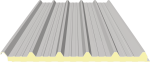
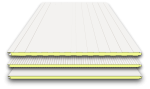
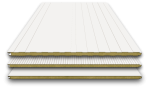
Solution: Sandwich panels integrate an insulating core made of polyurethane (PU) or PIR in the factory. U-values of up to 0.11 W/m²K guarantee optimum thermal insulation without subsequent measures.
2. no sound insulation
Trapezoidal sheet metal offers practically no sound insulation. The thin metal transmits noise almost undamped:
Loud rain noise: Rain pattering loudly on the sheet metal. This is disruptive in residential buildings or offices and hinders concentration in workshops.
Outside noise penetrates: Road traffic, neighbours, machines - all outside noises are clearly audible in the interior.
No privacy: conversations and noises from the building can be heard outside. Unsuitable for offices, meeting rooms or living areas.
Solution: The insulating core of sandwich panels absorbs sound waves much better. Rain noise is noticeably dampened and external noise is reduced.
3. condensation and moisture
One of the most common problems with trapezoidal sheet metal: condensation on the inside.
How does condensation form? Warm indoor air meets the cold trapezoidal sheet metal. The moisture in the air condenses - it drips from the ceiling and walls.
The consequences:
- Vehicles, machines and tools rust
- Stored goods become damp and mouldy
- Wooden structures rot
- Electrical systems can be damaged
Condensation occurs particularly in garages, workshops and warehouses as soon as heating or moisture is introduced (e.g. through wet vehicles).
Solution: Sandwich panels prevent condensation thanks to an integrated vapour barrier and continuous insulation. The inside remains dry - vehicles and stored goods are protected.
4. thermal bridges with retrofit insulation
Anyone who insulates trapezoidal sheet metal retrospectively has to contend with unavoidable thermal bridges:
Causes: Every fixing screw, every support of the substructure, every purlin breaks through the insulation layer. Metal conducts cold - heat loss occurs at these points.
Consequences:
- Theoretical U-values are not achieved
- Energy losses remain
- Condensation forms on thermal bridges
- Insulation effect is reduced by 20-40 %
Even with professional retrofit insulation, thermal bridges cannot be completely avoided.
Solution: Sandwich panels do not have continuous metal profiles. The insulation is foamed over the entire surface and thermal bridges are minimised.
5. leaks at joints and fastenings
Trapezoidal sheet constructions are prone to leaks:
Critical points:
- Overlaps between sheets
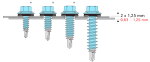
- Fastening screws (every screw is a potential leak)
- Connections to walls, chimneys, ventilation
- Ridge and eaves areas
Causes: Thermal movement due to temperature fluctuations, deteriorating seals, incorrect installation, over-tightening of screws.
Consequences: Water ingress damages insulation, timber constructions and the interior. Leaks often only become apparent years later.
Solution: Sandwich panels have factory-fitted seals in a tongue and groove system. Fewer fixing points mean less risk of leakage. The construction is tighter due to the system.
6. susceptibility to corrosion and rust
Despite galvanisation and coating, trapezoidal sheeting is not immune to corrosion:
Weak points:
- Cut edges during cutting (zinc protection interrupted)
- Damage to the coating during transport and installation
- Holes for fastening screws
- Scratches and dents
Aggressive environments: Salty sea air, chemical vapours in industrial areas, ammonia in agricultural buildings accelerate corrosion.
Consequences: Rust stains appear, spread, the sheet metal is perforated. Repairs are time-consuming and often the entire panel has to be replaced.
Solution: Sandwich panels have closed edges without exposed interfaces. The coating is protected all round. Stainless steel or GRP inner shells are available for aggressive environments.
7 Complex maintenance and limited service life
Trapezoidal sheet requires regular maintenance for optimum service life:
Necessary measures:
- Annual inspection of the fastening screws
- Checking and replacing the seals
- Removal of leaves, moss and organic deposits
- Repair of minor damage
- Check for corrosion and rust formation
Neglected maintenance: Loosened screws lead to leaks, defective seals let in water, small rust spots spread.
Service life: 25-35 years with optimum maintenance. Significantly shorter in aggressive environments or if neglected.
Solution: Sandwich panels are low-maintenance. The closed construction minimises maintenance requirements. No vapour barriers to check, no rear ventilation to clean, no annual screw checks necessary.
When trapezoidal sheeting still makes sense
Despite the disadvantages mentioned, trapezoidal sheet metal remains the right choice for certain applications:
Unheated storage: materials that do not require constant temperatures can be stored economically under trapezoidal sheeting.
Open roofing: Carports, canopies, shelters without side walls do not require insulation.
Agricultural sheds: Open field crop sheds, machine sheds without heating benefit from cost-effectiveness.
Temporary buildings: Construction site containers, temporary warehouses with a short useful life do not justify high-quality solutions.
Tight budgets: Where funding is absolutely limited, trapezoidal sheeting can serve as an entry-level solution.
Objectively speaking: For these applications, the disadvantages are actually not relevant. Here, trapezoidal sheet metal is a sensible and economical choice.
The solution: sandwich panels avoid all 7 disadvantages
Sandwich panels for roofs and sandwich panels for walls solve all the disadvantages mentioned above through integrated construction:
H3: How sandwich panels solve the problems
- Integrated thermal insulation: Insulation core made of PU or PIR foamed in at the factory. U-values 0.19-0.44 W/m²K guaranteed.
- Better sound insulation: Insulation core absorbs sound waves. Rain noise significantly dampened, outside noise reduced.
- No condensation: Integrated vapour barrier prevents moisture ingress. The inside remains dry.
- Minimised thermal bridges: Full-surface foamed insulation without continuous metal profiles. Tongue and groove system prevents linear thermal bridges.
- System-related tightness: Factory-fitted seals in the tongue and groove system. Fewer fixing points = less risk of leakage.
- Better corrosion protection: Closed edges without exposed interfaces. All-round protected coating.
- Maintenance-free: Closed construction without separate insulation levels, vapour barriers or rear ventilation. Minimal maintenance required.
Comparison: Trapezoidal sheet vs. sandwich panels
|
Disadvantage |
Trapezoidal sheet metal |
Sandwich panels |
|
Thermal insulation |
None, required separately |
Integrated, U-value up to 0.11 W/m²K |
|
Sound insulation |
Practically none |
Significantly better |
|
Condensation |
Drip formation |
Prevents |
|
Thermal bridges |
Unavoidable with post-insulation |
Minimises |
|
leaks |
High risk |
System-related tightness |
|
Corrosion |
Vulnerable at interfaces |
Protected edges |
|
Maintenance |
Required annually |
Maintenance-free |
The higher purchase costs of sandwich panels are amortised by the energy savings, lack of retrofitting costs, lower maintenance and longer service life. Further technical details can be found in our detailed guide to sandwich panels.
Conclusion: making the right decision
Trapezoidal sheet metal has clear advantages: economical, quick to install, robust. It remains the right choice for unheated warehouses, open roofing and temporary structures.
However, the 7 disadvantages are real and become a problem for heated buildings, comfort requirements or long-term quality. Condensation, lack of insulation and leaks cannot be completely avoided with trapezoidal sheet metal - only mitigated at a considerable cost.
Sandwich panels solve all 7 problems thanks to their factory-integrated design. The higher investment is worthwhile for all projects with insulation requirements, comfort demands or long-term use.
Our recommendation: Decide according to use and requirements. Unheated storage? Trapezoidal sheet metal. Heated garage, workshop or production hall? Sandwich panels. Let us advise you individually on the best solution for your project. Successful reference projects demonstrate the versatility of modern building solutions.
Last updated Nov 2025