

Trapezoidal sheet metal carport: planning, assembly & insulated side walls
A trapezoidal sheet metal carport offers economical protection for vehicles from the weather. The robust sheet steel roofing impresses with its durability, quick installation and low costs. Trapezoidal sheet metal is ideal for carport roofs and is available in various profile heights and colours.
However, while trapezoidal sheeting has proven properties as a roof covering, there are clear weaknesses when it comes to side walls. If you want to design a closed carport, you should opt for modern sandwich panels for the wall panelling. They offer better protection, insulation and comfort.
What is a trapezoidal sheet metal carport?
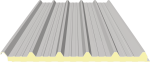
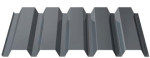
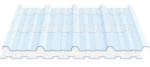
A carport with trapezoidal sheet metal is an open or partially closed shelter for vehicles with a roof made of profiled sheet steel. The trapezoidal corrugations give the thin sheet metal (typically 0.5-0.75 mm) the necessary stability for the roofing.
Trapezoidal sheet metal carports are mainly found on detached houses, apartment blocks and commercial properties. They protect vehicles from rain, snow, hail and UV radiation. Installation is straightforward and the galvanised, coated surface guarantees a service life of 25-35 years.
Typical designs:
- Single carport for 1 vehicle
- Double carport for 2 vehicles
- Row carport for several parking spaces
- Open (roof only) or closed (with side walls)
The construction consists of a supporting structure (wooden or steel posts), purlins as the roof substructure and the trapezoidal sheet metal cladding. Side walls or a rear wall to the weather side are optionally attached.
Planning a carport with trapezoidal sheet metal
Carport authorisation and building law
The authorisation requirement for carports varies depending on the federal state and municipality. The following generally applies:
Permit-free often up to: 30-50 m² roofed area (depending on the federal state), distance to the property boundary maintained, no closed walls to the street
Requires authorisation mostly for: Larger carports, border development, closed designs, deviations from the development plan
Important: Building regulations must also be complied with for carports that do not require authorisation: Spacing, ridge height, roof pitch, design specifications. A building notification may be required.
Before starting construction, check with your building authorisation authority whether a permit is required. Unauthorised construction will result in fines and, in the worst case, an obligation to demolish the building.
Roof pitch and construction
Trapezoidal sheet metal requires a minimum roof pitch of 5° (8.7 %), but 7-10° (12-17 %) is recommended for reliable water drainage. If the pitch is too low, water accumulates, snow load becomes critical and service life is reduced.
Design considerations:
- Purlin spacing depends on profile height (typically 1.5-2.5 m)
- Include snow load of the region
- Consider wind load, especially for open carports
- Statically check connection to existing building
The statics must take into account the dead weight, snow load and wind loads. A structural analysis is required for larger carports or special constructions. You can calculate the required snow load for your project in order to choose the right construction.
Installation of the trapezoidal sheet metal roof covering
Substructure and fastening
The substructure of a carport roof typically consists of purlins (timber or steel profiles) that rest on the supports. The distance between the purlins depends on the profile height of the selected trapezoidal sheet metal.
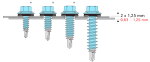
Fastening: Trapezoidal sheeting is fastened exclusively in the raised beads (on the profiles) using self-drilling trapezoidal sheeting screws. Each screw requires an EPDM sealing washer to prevent water ingress. The fastening distance is typically every 3-5 profile corrugations.
Important: The screws must not be overtightened. The seal should compress slightly, but not deform the sheet metal. Over-tightening will damage the coating and reduce the sealing effect.
Laying the trapezoidal sheet
The sheet is laid at right angles to the roof pitch, starting on the side facing away from the weather:
- Align the first sheet precisely and fix it temporarily
- Overlap the second sheet: at least half a profile wave
- Press the sheets together at the joint for optimum sealing
- Final screw connection after complete alignment
- Install the eaves flashing and verge flashing as a finish
The overlap in the longitudinal direction is 150-300 mm, depending on the roof pitch. A larger overlap is required for lower pitches. Trapezoidal sheeting can be manufactured in lengths of up to 12 metres in the factory, so that cross joints are often not necessary.
Design: Trapezoidal sheet metal is available in various RAL colours. Standard colours such as RAL 7016 (anthracite grey), RAL 9002 (grey white) or RAL 9006 (white aluminium) are suitable for most buildings.
Carport side walls: open or closed?
Advantages of closed carports
While open carports only protect the roof, a closed carport offers significantly more advantages:
Better weather protection: closed side walls protect against rain, snow and wind hitting the sides. Vehicles stay drier and door locks do not freeze.
Security: Closed carports with lockable doors protect against theft and vandalism. Valuable vehicles, bicycles or garden tools are better protected.
Versatile use: An enclosed carport is not only used as a shelter, but also as a storage room, workshop or hobby room.
Increase in value: Enclosed carports increase the property value more than open constructions.
However: A fully enclosed carport often requires planning permission, even if an open carport would not require authorisation. Clarify this with the building authorities in advance.
Trapezoidal sheet metal as wall cladding
Many builders use trapezoidal sheeting not only for the roof, but also for the side and rear walls. It is installed vertically or horizontally on a substructure in the same way as the roof cladding.
Advantages: Uniform appearance with the roof, cost-effective, quick installation, weather-resistant
Disadvantages: No thermal insulation, no sound insulation, condensation forms on the inside, no burglary protection, unattractive appearance
Trapezoidal sheet walls are suitable for purely weather protection purposes for open or semi-open carports. For closed carports with higher requirements, however, there are clear weaknesses.
Problem: Uninsulated trapezoidal sheet metal walls
Trapezoidal sheet metal wall cladding offers practically no thermal insulation. This leads to problems with closed carports that are used as workshops, storage rooms or for temperature-sensitive uses:
Condensation: In winter, humidity condenses on the cold inside of the trapezoidal sheet metal. Dripping condensation damages stored objects and promotes corrosion.
Temperature fluctuations: Without insulation, the carport heats up considerably in summer and is freezing cold in winter. It is uncomfortable to use as a workshop.
No sound insulation: Trapezoidal sheet metal offers practically no sound insulation. Rain pours down loudly on the sheet metal, noise from outside penetrates unhindered.
Lack of stability: Thin trapezoidal sheet metal (0.5-0.75 mm) is susceptible to deformation and offers no protection against break-ins. A kick is enough to break through the sheet metal.
Unattractive appearance: From the inside, trapezoidal sheeting shows the bare metal back - not very inviting for a workshop or hobby room.
Trapezoidal sheet walls are therefore not an ideal solution for closed carports that require comfort, protection and versatility.
Insulated side walls with sandwich panels
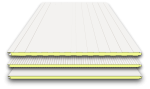
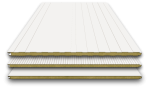
While trapezoidal sheet metal remains an economical solution for the carport roof, sandwich panels for walls offer clear advantages for side walls and rear walls. Wall panels combine external cladding, thermal insulation and internal panelling in one factory-made construction element.
Advantages of insulated wall panels
Integrated thermal insulation: sandwich panels achieve U-values of up to 0.11 W/m²K depending on the core thickness. The insulating core made of polyurethane (PU) or PIR prevents condensation and temperature fluctuations.
No condensation: The closed construction with integrated vapour barrier prevents moisture ingress. The inside remains dry - ideal for storage and workshop use.
Improved sound insulation: The insulating core absorbs sound waves significantly better than hollow trapezoidal sheet metal. The carport is quieter and more comfortable.
Greater stability: Sandwich panels with a core thickness of 40-100 mm are significantly more stable than thin trapezoidal sheet metal. They offer better burglary protection and can be walked on (with thicker variants).
Attractive appearance: The inside has a clean, coated surface. Various lines and colours allow for an attractive design. Various RAL colours are available.
Quick installation: sandwich panels are installed directly onto the substructure - without separate insulation, vapour barrier or interior cladding. One work step replaces several trades.
Maintenance-free: The closed construction minimises maintenance requirements. No need to check vapour barriers or rear ventilation.
Comparison: Trapezoidal sheet metal vs. sandwich panels for carport walls
|
Criterion |
Trapezoidal sheet metal |
Sandwich panels |
|
Thermal insulation |
None |
U-value up to 0.11 W/m²K |
|
Condensation protection |
No, drip formation |
Yes, dry |
|
Sound insulation |
Very low |
Significantly better |
|
Stability |
0.5-0.75 mm thin |
40-100 mm solid |
|
Burglary protection |
Practically none |
Significantly higher |
|
Interior appearance |
Bare metal |
Coated surface |
|
Installation |
Simple |
One operation |
|
Maintenance |
Low |
Maintenance-free |
|
Comfort of use |
Limited |
High |
Recommendation: Combine trapezoidal sheet metal for the roof with sandwich panels for the side walls and rear wall. This allows you to utilise the cost-effectiveness of trapezoidal sheeting where it makes sense and benefit from the advantages of integrated insulation for the walls. Further technical details can be found in our detailed guide to sandwich panels.
Conclusion: The right combination of materials for your carport
A trapezoidal sheet carport is an economical and proven solution for roofing. Trapezoidal sheeting impresses with its low costs, simple installation and durability. For open or semi-open carports, where only weather protection from above is required, trapezoidal sheet metal remains the first choice.
However, as soon as you want to attach side walls or a rear wall - whether for better weather protection, security or ease of use - the limits of trapezoidal sheeting become apparent. A lack of insulation, condensation problems and low stability make uninsulated sheet metal walls a sub-optimal solution.
The better choice: sandwich panels for walls combined with trapezoidal sheet metal for the roof. This combination of materials offers optimum value for money. The roof fulfils its function economically, the walls offer comfort and protection at a modern level.
Our recommendation: Let us advise you individually on which material combination is best for your carport project. From a simple roof covering to a fully enclosed, insulated carport, we offer suitable solutions. Successful reference projects demonstrate the versatility of modern carport constructions.
Last updated Nov 2025