




Trapezoidal sheet metal hall: Construction, insulation & industrial solutions
A trapezoidal sheet metal hall offers economical space for production, storage and agriculture. The robust sheet steel construction impresses with its fast assembly, large spans and low construction costs. Trapezoidal sheet metal buildings are proven lightweight buildings for a wide range of commercial requirements.
However, while trapezoidal sheet metal is an ideal solution for unheated warehouses, there are clear limitations for heated industrial halls. A lack of thermal insulation leads to high energy costs and condensation problems. Sandwich panels are the better alternative for modern production halls with insulation requirements.
What is a trapezoidal sheet metal hall?
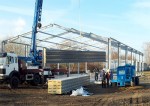
A hall with trapezoidal sheeting is a large-scale building whose roof and optionally the walls are made of profiled sheet steel. The trapezoidal corrugations give the material the necessary load-bearing capacity for wide-span constructions without additional intermediate supports.
Trapezoidal sheet metal halls can be found in industry, trade and agriculture. They are used as production halls, warehouses, logistics halls, workshops or agricultural machinery halls. The galvanised and coated surface guarantees a service life of 25-35 years when properly constructed.
Typical features:
- Wide-span constructions
- Fast assembly thanks to prefabricated elements
- Flexible floor plans without load-bearing internal walls
- Economical construction with low costs per square metre
- Expandable due to modular design
The construction consists of a steel frame (columns and transoms), purlins for the roof and wall panelling and the trapezoidal sheet metal cladding. A concrete foundation with floor slab forms the basis.
Lightweight hall: Economical hall construction
Advantages of lightweight construction
Trapezoidal sheet metal halls are lightweight halls - in contrast to solid masonry constructions or concrete halls. The lightweight construction method offers decisive advantages for hall construction:
Fast construction time: prefabricated steel structures and trapezoidal sheeting enable construction times of a few weeks instead of months. Assembly is not dependent on the weather.
Large spans: Steel girders span 10-40 metres without intermediate supports. Flexible space utilisation without load-bearing interior walls is possible.
Cost-effectiveness: Lightweight halls are more cost-effective than solid construction methods. Material and labour costs are significantly lower.
Expandable: The modular design enables later extensions by adding additional hall modules.
Flexibility: Doors, windows and openings can be easily retrofitted or relocated.
These advantages make lightweight halls the first choice for commercial and industrial companies with economic requirements.
Areas of application in hall construction
Trapezoidal sheet metal halls are suitable for a wide range of uses:
Unheated storage: materials, machinery, vehicles - where temperature protection is not an issue, trapezoidal sheeting is ideal.
Agriculture: Machine halls, field crop halls, open stables benefit from the economical construction method.
Logistics: transshipment halls and warehouses without heating requirements utilise the cost benefits.
Temporary use: Halls for seasonal production or temporary projects do not justify expensive solid construction.
Limited suitability: For heated production halls, temperature-controlled storage or rooms with comfort requirements, trapezoidal sheeting without insulation shows clear weaknesses.
Construction of a hall with trapezoidal sheeting
Supporting structure and substructure
The supporting structure of a trapezoidal sheet metal hall typically consists of
Steel frame: Supports (steel profiles) carry the roof structure. The spacing depends on the span width and snow load (typically 5-8 metres).
Transoms: Horizontal steel beams connect the columns and form the roof structure. Depending on the span width, solid wall girders or truss girders are used.
Purlins: Purlins (C or Z profiles) lie on the transoms at intervals of 1.5-3.0 metres. They form the direct support surface for the trapezoidal sheet metal.
Wind bracing: Diagonal struts stabilise the construction against wind loads.
The statics must take into account dead weight, snow load, wind loads and possibly crane loads. Sophisticated structural calculations are required for long-span halls over 20 metres.
Roof and wall panelling
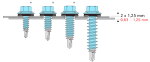
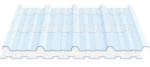
Roof cladding: Trapezoidal sheet metal is laid across the roof pitch on the purlins. The minimum pitch is 5° (8.7 %), 7-10° is recommended for reliable water drainage in halls. Fastening is carried out exclusively in the raised beads using self-drilling screws with EPDM seals.
Trapezoidal sheets are available from the factory in lengths of up to 24 metres, so that no cross joints are required for typical hall depths. The overlap is at least half a profile wave.
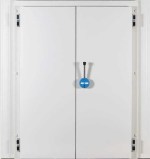
Wall panelling: Walls are constructed in the same way as the roof. Vertically or horizontally laid trapezoidal sheets are screwed onto wall purlins. Gates, windows and personnel doors are planned as openings and fitted with appropriate frames.
Design: Trapezoidal sheeting is available in various RAL colours. RAL 7016 (anthracite grey), RAL 9002 (grey-white) or RAL 9006 (white aluminium) are often used for prestigious industrial halls.
Insulating a trapezoidal sheet metal hall: When and how?
Unheated vs. heated halls
Whether a trapezoidal sheet metal hall needs insulation depends on its use:
Unheated halls - insulation often not necessary:
- Storage of insensitive materials
- Machine halls with no staff present
- Open agricultural halls
- Logistics halls without temperature requirements
Here, trapezoidal sheeting without insulation is an economical and sensible solution. The lack of insulation does not matter if it is not heated anyway.
Heated halls - insulation is essential:
- Production halls with working personnel
- Temperature-controlled storage (e.g. for sensitive goods)
- Workshops with heating requirements
- Halls with permanent staff presence
A lack of trapezoidal sheet metal leads to massive problems here: Energy losses through the roof are enormous, condensation drips from the ceiling and heating costs explode. Insulation becomes an economic necessity.
Challenges with retrofit insulation
Retrofitting insulation to a trapezoidal sheet metal hall is possible, but costly:
Under-rafter insulation (from the inside): A substructure with insulation, vapour barrier and internal cladding is installed under the trapezoidal sheeting. This reduces the clear height by 15-30 cm and requires complex vapour barrier bonding. Thermal bridges through the substructure are unavoidable.
Roof insulation (from the outside): Insulation boards are laid on the existing trapezoidal sheet metal, with new roof waterproofing on top. This requires scaffolding, is dependent on the weather and places an additional load on the statics.
Blow-in insulation: Theoretically possible for closed cavities, but rarely practicable for trapezoidal sheet metal halls.
Problems with all methods:
- High time and cost expenditure
- Thermal bridges through purlins and substructure
- Complex vapour barrier to prevent condensation
- Loss of room height with internal insulation
- Production interruption during the construction period
Subsequent insulation is more expensive than factory-insulated solutions from the outset.
Sandwich panels for hall construction: the insulated solution
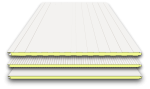
For heated industrial halls and production halls, sandwich panels for roofs and sandwich panels for walls offer a complete insulated solution right from the start. Sandwich panels combine external cladding, thermal insulation and internal panelling in one factory-made construction element.
Advantages for industrial halls
Integrated thermal insulation: sandwich panels achieve U-values of up to 0.11 W/m²K depending on the core thickness (40-200 mm). The insulating core made of polyurethane (PU) or PIR is fully foamed in - no thermal bridges through purlins or substructure.
No condensation: the integrated vapour barrier prevents condensation. The hall ceiling remains dry - production machines and stored goods are protected.
Energy efficiency: Heated halls with sandwich panels consume 40-60 % less heating energy than subsequently insulated trapezoidal sheet metal halls. The investment is amortised through energy savings.
Quick installation: sandwich panels are mounted directly onto the purlins - without separate insulation, vapour barrier or internal cladding. The construction time is significantly reduced compared to multi-layer constructions.
No loss of room height: the insulation is integrated into the panel thickness. The clear height is maximised - important where building heights are limited.
Attractive appearance: The inside has a clean, coated surface. A clear advantage over bare trapezoidal sheet metal for production halls with customer traffic or prestige requirements.
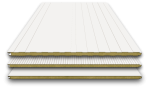
Fire protection: Sandwich panels with a rock wool core achieve fire resistance classes up to EI120 - important for halls with fire protection requirements.
Comparison: Trapezoidal sheet metal vs. sandwich panels for halls
|
Criterion |
Trapezoidal sheet (uninsulated) |
Trapezoidal sheet + post-insulation |
Sandwich panels |
|
Thermal insulation |
None |
U-value 0.25-0.40 W/m²K |
U-value 0.19-0.44 W/m²K |
|
Condensation protection |
No, drip formation |
Risk remains |
Yes, dry |
|
Thermal bridges |
Not relevant |
Unavoidable |
Minimised |
|
Installation time |
Quick |
Several weeks |
Quick |
|
Room height |
Maximum |
Reduced (-15-30 cm) |
Maximum |
|
Energy costs |
Very high (heated) |
Medium |
Low |
|
Interior appearance |
Bare metal |
Cladding |
Coated |
|
Suitability unheated |
Optimal |
- |
Optimal |
|
Suitability heated |
Unsuitable |
Satisfactory |
Optimal |
|
Economic efficiency |
Favourable initially |
Expensive afterwards |
Optimal in the long term |
Application recommendation: Trapezoidal sheet metal remains the economical choice for unheated warehouses. Sandwich panels are the better solution for heated production halls, temperature-controlled storage and halls with comfort requirements. The integration of insulation and cladding eliminates typical problems of uninsulated or retrofitted insulated halls. Further technical details can be found in our detailed guide to sandwich panels.
Conclusion: Choosing the right hall solution
A trapezoidal sheet metal hall is a proven and economical lightweight hall for a wide range of commercial requirements. For unheated storage, agricultural use and logistics without temperature requirements, trapezoidal sheeting offers optimum value for money.
However, as soon as heating comes into play, the limits of uninsulated trapezoidal sheet metal constructions become apparent. Energy losses, condensation and a lack of comfort make subsequent insulation unavoidable - at considerable expense and effort.
For modern industrial halls with insulation requirements, factory-insulated sandwich panels are the better choice from the outset. They offer optimum U-values, prevent condensation, save construction time and ensure low energy costs in the long term.
Our recommendation: Let us advise you individually on which hall solution is best for your requirements. Unheated storage? Trapezoidal sheet metal. Heated production? Sandwich panels. From simple machine halls to modern production facilities, we offer suitable systems. Successful reference projects demonstrate the versatility of modern hall constructions.
Last updated Nov 2025