
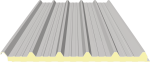
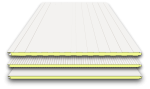
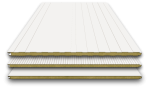
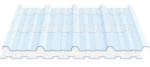

Buy trapezoidal sheet metal at a favourable price: Price comparison & long-term costs
Trapezoidal sheet metal is an economical solution for roofs and walls - but the cheapest price is not always the best choice. Those who only compare the purchase price often overlook hidden costs for the substructure, installation and subsequent insulation. In heated buildings, these follow-up costs can quickly cancel out the supposed price advantage.
This article shows what trapezoidal sheeting really costs, where you can buy it cheaply without compromising on quality, and which hidden costs you need to take into account when calculating. A profitability comparison over 20 years shows: The cheapest purchase price is not always the most economical solution.
What does trapezoidal sheeting cost? Price factors at a glance
The price of trapezoidal sheeting varies considerably - depending on the material, design and quality.
Material thickness and profile height
Sheet thickness: Trapezoidal sheet metal is typically 0.5-0.75 mm thick. Thinner material (0.4 mm) is cheaper, but less stable and more susceptible to corrosion. Thicker material (0.7-0.75 mm) costs more but lasts longer.
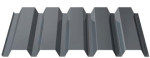
Profile height: The height of the beading determines the load-bearing capacity and price:
- Low profiles (20-35 mm): Cheaper, but closer purlin spacing required
- Medium profiles (35-60 mm): Standard range, good price-performance ratio
- High profiles (60-200 mm): More expensive, but larger spans possible
Higher profiles cost more per m², but save on the substructure (fewer purlins required).
Coating and corrosion protection
The coating protects against corrosion and UV radiation - and has a significant impact on the price:
Galvanisation: all trapezoidal sheets are galvanised (zinc coating 100-275 g/m²). Higher zinc coating = better corrosion protection = higher price.
Painting:
- Standard polyester (25 μ): Cheapest option, sufficient for normal environments
- PVDF (35 μ²): Significantly more expensive, but better UV resistance and longer service life
- Plastisol (200 μ): Thickest coating, highest price, maximum protection
Rule of thumb: High-quality coating costs 20-40 % more, but extends the service life by years. In aggressive environments (coastal, chemical, agricultural), the investment is economical.
Typical prices for trapezoidal sheet metal
Price overview by application
Prices vary depending on quality, coating and purchase quantity. The following guide values apply to standard RAL colours:
Trapezoidal sheet metal price table (guide values per m²):
|
Type |
Sheet thickness |
Coating |
Price per m² |
|
Simple roof sheet |
0.5 mm |
Standard polyester |
8-12 € |
|
Standard roofing sheet |
0.63 mm |
Standard polyester |
10-15 € |
|
Premium roofing sheet |
0.75 mm |
PVDF |
15-22 € |
|
Simple wall sheet |
0.5 mm |
Standard polyester |
7-11 € |
|
Standard wall plate |
0.63 mm |
Standard polyester |
9-14 € |
|
High quality coated |
0.75 mm |
Plastisol |
18-25 € |
Important: These prices apply to larger quantities (> 100 m²). Small quantities are 20-30 % more expensive. Special colours cost 15-25 % more. Stock items in standard colours are often cheaper.
All cost figures are rough guidelines and can vary greatly depending on the region, project size and specific requirements. For a precise calculation, we recommend an individual consultation.
H3: Don't forget additional costs
The pure sheet metal price is only part of the total costs:
Fixing materials:
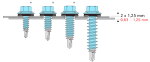
- Trapezoidal sheet metal screws with sealing disc: € 0.15-0.25 per piece
- Requirement: 4-7 screws per m² (roof), 3-5 screws per m² (wall)
- Costs: approx. 1-2 € per m²
End plates:
- Eaves sheet, verge, ridge, gable sheet: 8-15 € per running metre
- Depending on the building geometry: 5-15 % of the sheet metal costs
Sealing tapes:
- For overlaps and longitudinal joints: € 2-5 per linear metre
- Requirement: € 1-2 per m² roof area
Transport:
- For sheets over 12 m long: special transport required
- Costs vary from region to region (€ 200-600 depending on distance)
The additional costs add up to 10-20 % of the pure sheet metal costs. Always take this into account when calculating.
Where to buy trapezoidal sheet metal cheaply?
A comparison of sources of supply
Online retailers: Often the cheapest prices due to low overheads. Wide selection, transparent prices, convenient delivery. Disadvantage: No on-site advice, shipping costs for small quantities.
Building materials dealers: Medium price segment. Advantage: Personal advice, on-site inspection, local availability. Useful for first-time customers who need advice.
Manufacturer direct: Often the most favourable option for larger projects (> 500 m²). Customised cuts at no extra charge.
DIY store: Most expensive option. Only suitable for small quantities and emergencies. Prices 30-50 % above online trade.
Recommendation: Check the offers on our website and benefit from ordering directly from the manufacturer.
Use stock items and special offers
Stock items: Trapezoidal sheets in standard colours (RAL 9002, 9006, 7016, 8012) and standard lengths are often 15-30 % cheaper than custom-made products. The quality is identical - only the colour and length are specified.
Check our special offers regularly. Construction site returns (1st choice, but incorrect production) offer considerable savings potential without any loss of quality.
When is stock worthwhile?
- With flexible colour selection (standard colours acceptable)
- If lengths match the building geometry
- With time flexibility (utilise current availability)
When is customisation better?
- Special RAL colours required (e.g. corporate design)
- Exact lengths required (avoids offcuts and longitudinal joints)
- Very large or very small order quantities
The savings on stock goods justify small compromises in colour or length. The price advantage is often 20-30 %.
Hidden costs with cheap trapezoidal sheets
Substructure and installation
The sheet price is just the tip of the iceberg. The substructure for trapezoidal sheet metal often causes higher costs than the sheet metal itself.
Substructure (uninsulated):
- Purlins (wood or steel): 8-15 € per m² roof area
- Fastening material: 2-4 € per m²
- Labour time for installing purlins: 15-25 € per m²
- Total substructure: 25-45 € per m²
Installation of trapezoidal sheet metal:
- Labour time for laying and screwing: 10-20 € per m² (roof), 8-15 € per m² (wall)
- Installing end sheets: 5-10 € per running metre
- Total installation: 15-30 € per m²
The total costs for the substructure and installation often exceed the price of the material alone. With a cheap trapezoidal sheet for 10 € per m², 40-75 € per m² are added for substructure and installation. The total cost is €50-85 per m² - not €10.
You can find detailed information on professional screw fastening in our installation guide.
All cost figures are rough guidelines and can vary greatly depending on the region, project size and specific requirements. For a precise calculation, we recommend an individual consultation.
Retrofit insulation for heated buildings
The biggest hidden cost problem: trapezoidal sheet metal is not insulated. This does not matter for unheated warehouses. For heated warehouses, it becomes expensive.
Cost of subsequent insulation:
- Insulation (mineral wool 120 mm): 8-12 € per m²
- Bonding vapour barrier airtight: 3-5 € per m²
- Counter battens and supporting battens: 8-12 € per m²
- Interior panelling (optional): 10-18 € per m²
- Labour time: 25-40 € per m²
- Total post-insulation: 45-85 € per m²
Retrofitting insulation is more complex and more expensive than factory-insulated solutions. It also reduces the room height by 15-30 cm. Thermal bridges through the battens are unavoidable.
Calculation example 200 m² roof (heated):
- Trapezoidal sheet cheap: 10 € × 200 = 2,000 €
- Substructure + installation: 60 € × 200 = 12,000 €
- Post-insulation: 65 € × 200 = 13,000 €
- Total costs: € 27,000
The supposedly favourable sheet metal price of € 2,000 explodes to a total cost of € 27,000. The subsequent insulation costs more than the sheet metal itself.
All cost figures are rough guidelines and can vary greatly depending on the region, project size and specific requirements. For a precise calculation, we recommend an individual consultation.
Long-term cost-effectiveness: more than just the purchase price
Service life and maintenance costs
Service life of trapezoidal sheet:
- Standard coating (polyester 25 μ): 20-25 years
- High-quality coating (PVDF): 30-40 years
- In aggressive environments: 30-50 % shorter service life
The coating ages due to UV radiation, corrosion and mechanical stress. The first signs of rust appear after 15-20 years (standard coating). High-quality coatings cost 20-40 % more, but last 10-15 years longer.
Maintenance: Trapezoidal sheet metal is low-maintenance. Annual visual inspections are recommended (tightness, screws, rust). Repairing minor damage at an early stage prevents major consequential damage.
Replacement: Replacement is necessary after 25-40 years. Costs identical to initial installation (material + dismantling + disposal + new installation).
Energy costs for uninsulated constructions
The biggest long-term cost factor for heated buildings: energy loss due to uninsulated roof and walls.
Example calculation 200 m² hall roof (heated to 15°C):
- U-value trapezoidal sheet metal uninsulated: approx. 5.0 W/m²K
- U-value with post-insulation: approx. 0.30 W/m²K
- Energy loss uninsulated: approx. 150 kWh/m² per year
- Insulated energy loss: approx. 9 kWh/m² per year
- Difference: 141 kWh/m² per year
For 200 m² roof area:
- Additional consumption without insulation: 28,200 kWh/year
- Heating costs at € 0.08/kWh (gas): € 2,256 per year
- Heating costs over 20 years: € 45,120
The energy costs over 20 years exceed the total construction costs. Retrofitting insulation for €13,000 amortises after just 6 years through energy savings.
Conclusion: For heated buildings, an uninsulated trapezoidal sheet metal construction is economically fatal. The € 13,000 in insulation costs saved are more than offset by € 45,000 in energy costs.
Sandwich panels: Higher price, better economy
Cost comparison over 20 years
For heated halls and buildings, sandwich panels for roofs and sandwich panels for walls are more economical in the long term, despite the higher purchase price.
Comparative calculation 200 m² roof (heated):
Variant 1: Trapezoidal sheet + post-insulation
- Trapezoidal sheet metal: € 2,000
- Substructure + installation: 12,000 €
- Post-insulation (retrospective): 13.000 €
- Energy costs 20 years: € 3,600 (U-value 0.30)
- Total costs 20 years: € 30,600
Variant 2: Sandwich panels (100 mm PU core)
- Sandwich panels: € 6,000 (€ 30/m²)
- Substructure (simplified): € 8,000
- Assembly: € 4,000
- Energy costs 20 years: € 3,600 (U-value 0.28)
- Total costs 20 years: € 21,600
Savings with sandwich panels: € 9,000 over 20 years
The sandwich panels are €18,000 more expensive to purchase (€6,000 instead of €2,000 material, but €12,000 instead of €25,000 total construction costs). In the long term, they are €9,000 cheaper, as there is no need for costly re-insulation.
Additional advantages of sandwich panels:
- Faster installation (3 work steps instead of 7)
- No reduction in room height
- Factory airtightness (suitable for blower door)
- Minimised thermal bridges
- Better sound insulation
You can find more details in our comprehensive guide to sandwich panels.
When is the investment worthwhile?
Sandwich panels are worthwhile for:
- Heated halls and buildings (energy savings dominate)
- Projects with time pressure (significantly faster installation)
- Comfort requirements (better sound insulation, no condensation)
- Blower door requirements (factory airtightness)
- Limited room height (no reduction through additional insulation)
Trapezoidal sheet remains more favourable for:
- Unheated warehouses (insulation not required)
- Very tight budgets (lowest initial investment)
- Temporary buildings (short service life)
- Agricultural buildings without heating
The decision depends on the utilisation. For unheated warehouses, trapezoidal sheeting remains the most economical solution. For heated production halls, temperature-controlled storage and buildings with comfort requirements, sandwich panels are more favourable in the long term - despite the higher purchase price. Successful reference projects show economical solutions in practice.
Conclusion: Buy cheaply without expensive follow-up costs
Buying trapezoidal sheeting cheaply makes sense if the overall costs are right. The pure sheet metal price is only a small part of the investment. The substructure, installation and, in the case of heated buildings, subsequent insulation often triple the sheet metal costs.
Trapezoidal sheet metal remains the most economical solution for unheated warehouses, agricultural halls and temporary buildings. Take advantage of stock items and special offers for additional savings. Ensure that the coating quality is sufficient. High-quality coatings cost 20-40 % more, but extend the service life considerably.
However, as soon as heating comes into play, the priorities shift. The energy costs over 20 years exceed the construction costs. Retrofitting insulation is more expensive than factory-insulated sandwich panels. The higher initial investment is amortised through energy savings, faster installation and better building quality.
Our recommendation: Calculate not only the purchase price, but also the total costs over the planned service life. For unheated use: buy trapezoidal sheeting at a favourable price. For heated use: sandwich panels. Let us advise you individually as to which solution is economically optimal for your project.
Last updated Nov 2025