

Trapezoidal sheet metal wall panelling: Installation, costs & modern alternatives
Trapezoidal sheet metal for walls offers a cost-effective solution for cladding commercial and industrial buildings. The characteristic profiling ensures stability and gives buildings a modern, technical look. When planning, however, you should consider the overall costs, including any necessary insulation measures, as modern alternatives are often more economical.
What is trapezoidal sheet metal for wall cladding?
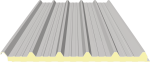
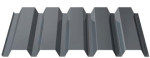
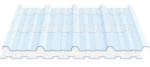
Trapezoidal sheet metal as wall cladding consists of profiled sheet steel with characteristic trapezoidal corrugations. This profiling gives the relatively thin material the necessary rigidity for use as façade cladding.
Structure and materials
Standard structure of trapezoidal sheet metal wall cladding:
- Base material: Galvanised sheet steel (thickness 0.50-0.75 mm)
- Coating: Polyester or PVDF paint
- Profile height: 18-50 mm depending on application
- Widths: 900-1250 mm usable width
The corrosion protection class depends on the environment: RC2 for normal conditions, RC3-RC4 for aggressive industrial environments or near the coast.
Areas of use and applications
Trapezoidal sheet wall panelling is mainly used for
- Commercial halls and industrial buildings
- Warehouses and logistics centres
- Agricultural buildings in hall construction
- Modernisation of existing facades
The low material thickness makes additional thermal insulation necessary in most cases.
Trapezoidal sheet wall installation: step-by-step instructions
The professional installation of trapezoidal sheet metal on the wall requires well thought-out planning and precise execution.
Requirements and substructure
Prepare the substructure:
- Check load-bearing capacity: Static calculation for wind and dead loads
- Install purlins: Horizontal support profiles at intervals of 2-4 m (depending on profile and load)
- Attach vapour barrier: Mandatory for heated buildings
- Install insulation: Mineral wool or rigid foam boards between the purlins
The substructure must be able to absorb the wind loads in accordance with DIN EN 1991-1-4.
Fastening and installation sequence
Assembly sequence:
- Align the first sheet: At right angles to the eaves, note the overhang
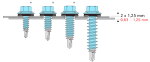
- Fastening: Suitable fastening screws in the raised bead
- Lateral overlap: At least one bead width
- Sealing: Butyl tape or sealing cords at the joints
Important: The screws must be fitted with sealing discs to prevent leaks.
Avoid common installation problems
Typical sources of error:
- Inadequate fastening: Use at least 6-8 screws per m²
- Thermal bridges: Vapour barrier not interrupted
- Condensation: Provide rear ventilation with external insulation
- Deformations: Transport and storage on level surfaces
Costs for trapezoidal sheet wall cladding
The cost-effectiveness of trapezoidal sheet metal depends heavily on the total costs, including insulation and installation.
Material costs at a glance
Price overview of trapezoidal sheet wall cladding (rough estimate, net, ex works):
|
Material |
Price per m² |
Coating |
Service life |
|---|---|---|---|
|
Standard galvanised |
8-12 €/m² |
Polyester 25μ |
15-20 years |
|
High quality coated |
12-18 €/m² |
PVDF |
20-25 years |
|
Special colours |
+15-25% |
According to RAL |
Variable |
Rough price estimate without substructure and installation
Additional costs for insulation
Insulation structure causes additional costs (rough estimate):
- Mineral wool insulation: 15-25 €/m² (incl. vapour barrier)
- Substructure: 8-15 €/m²
- Rear ventilation: 3-8 €/m²
- Additional labour time: +30-50% of the installation costs
Total costs quickly reach 35-60 €/m² for an insulated trapezoidal sheet metal façade.
Labour costs and installation time
Installation costs (rough guide values):
- Simple installation: 3-5 m²/h per fitter
- With insulation: 1.5-2.5 m²/h per fitter
- Labour costs: 45-65 €/h depending on region
- Installation costs: 25-35 €/m² for professional installation
The multi-stage installation process (substructure → insulation → vapour barrier → cladding) increases the time required considerably.
Thermal insulation for trapezoidal sheet metal facades
The thin sheet thickness makes trapezoidal sheet metal unsuitable for heated buildings without additional insulation.
Why additional insulation is necessary
Physical limits:
- U-value uninsulated: 5.0-6.0 W/m²K (insufficient)
- EnEV requirements: Maximum 0.24 W/m²K for external walls
- Thermal bridges: Fixing points transmit cold
- Condensation risk: Moisture damage occurs without insulation
Insulation solutions and their challenges
Conventional insulation variants:
1. insulation between rafters:
- Mineral wool between purlins
- Vapour barrier required on the room side
- Problem: thermal bridges at the purlins
2. over-rafter insulation:
- Insulation boards on the outside
- Problem: Complicated fastening, high costs
3. full thermal insulation (ETICS):
- Problem: Complex details at connections
Challenges of all solutions:
- Multiple installation levels
- Vapour diffusion and condensation problems
- Thermal bridges difficult to avoid
- High planning and implementation costs
Modern wall panelling: Integrated solutions
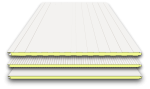
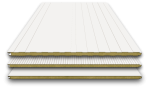
Modern construction methods rely on integrated system solutions that combine panelling and insulation in one component.
A comparison of contemporary alternatives
Modern wall panels offer decisive advantages:
- Integrated insulation: U-values up to 0.10 W/m²K without additional measures
- Single-layer installation: direct attachment to the supporting structure
- Thermal bridge-free: Continuous insulation layer without interruptions
- Vapour-tight: Factory-foamed edge connections
Advantages of continuous insulation systems
Technical superiority:
- No condensation problems: Monolithic construction
- Longer service life: Protection of the insulation through metal shells on both sides
- Better tightness: Profiled butt joints
- Less maintenance: fewer critical details
The high-quality insulation made of PIR achieves better values with a lower component thickness.
Trapezoidal sheet metal or modern wall panels?
An objective comparison shows the limits of conventional trapezoidal sheet metal construction.
Total cost comparison
Cost comparison (rough estimate per m² wall area):
|
Position |
Trapezoidal sheet + insulation |
Modern wall panels |
|---|---|---|
|
material |
25-35 €/m² |
35-45 €/m² |
|
Installation |
25-35 €/m² |
15-20 €/m² |
|
Details/connections |
8-15 €/m² |
3-6 €/m² |
|
Total costs |
58-85 €/m² |
53-71 €/m² |
Conclusion: For comparable total costs, integrated solutions offer significantly better insulation values.
All prices are rough estimates and may vary depending on the region, project size and market situation.
Installation time and effort
Time comparison (approximate values):
- Trapezoidal sheet metal with insulation: 4-6 work steps, 1.5-2.5 m²/h
- Modern wall panels: 1 work step, 4-8 m²/h
Reduced installation time means
- Lower labour costs
- Shorter construction time
- Fewer interruptions due to weather conditions
- Lower quality risk
For demanding projects with high insulation standards, modern wall cladding systems are economically and technically superior. They combine optimum insulation properties with efficient installation and long-lasting quality.
Last updated Nov 2025