

Trapezoidal sheet properties: Technical data & material comparison
Trapezoidal sheet metal is a profiled steel sheet for roofs and walls - economical, lightweight and quick to install. But what technical properties does the material really have? How strong is it, how corrosion-resistant, how thermally insulating?
This article explains the material structure of trapezoidal sheeting, shows its technical characteristics and assesses its strengths and weaknesses. A factual comparison with sandwich panels will help you decide on the material for your building project.
Material structure of trapezoidal sheet metal
Sheet steel as the base material
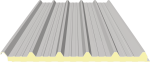
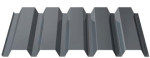
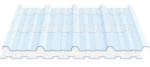
Trapezoidal sheet consists of cold-rolled sheet steel, which is formed into its characteristic trapezoidal shape by profile rolling. The trapezoidal corrugations give the thin sheet the necessary rigidity.
Material thicknesses: Typically 0.4-0.75 mm. Thinner sheet metal (0.4-0.5 mm) is cheaper, but has a lower load-bearing capacity and is more susceptible to corrosion. Thicker sheet metal (0.63-0.75 mm) costs more, but offers higher load-bearing capacity and a longer service life.
Profile shapes: The profile height (height of the beads) varies from 20 mm to 200 mm. Higher profiles are stiffer and allow larger spans between the purlins. Low profiles (20-35 mm) are mainly used for walls, high profiles (60-200 mm) for long-span roofs.
The steel itself is not corrosion-resistant. Without protection, it would rust within months. This is why every trapezoidal sheet is galvanised and coated.
Galvanisation as corrosion protection
Galvanising protects the steel from corrosion. The sheet is coated with a layer of zinc using a hot-dip galvanising process. Zinc is less noble than steel and corrodes first - the steel remains protected (sacrificial anode protection).
Zinc coating: Measured in g/m². Typical values:
- Z100: 100 g/m² zinc coating - most favourable variant, for interiors
- Z140: 140 g/m² - standard for normal outdoor applications
- Z275: 275 g/m² - high-quality protection for aggressive environments
Higher zinc coating = better corrosion protection = longer service life. Z275 is recommended in coastal areas, industrial areas or agricultural operations (ammonia).
Galvanisation alone is not sufficient for long-term protection. UV radiation and acid rain attack the zinc coating. For this reason, trapezoidal sheet metal is also painted.
Technical characteristics at a glance
Material thickness and weight
Typical material thicknesses and weights:
|
Sheet thickness |
Weight per m² |
Typical application |
|
0.40 mm |
4-5 kg/m² |
Walls, light roofs |
|
0.50 mm |
5-6 kg/m² |
Standard walls and roofs |
|
0.63 mm |
6-7 kg/m² |
Standard roofs |
|
0.75 mm |
7-9 kg/m² |
Highly loaded roofs |
Trapezoidal sheet metal is a lightweight construction material. Even thick sheet metal weighs only 7-9 kg/m². In comparison: roof tiles weigh 40-50 kg/m², concrete roofs 200-300 kg/m². The low weight reduces the demands on the foundation and supporting structure.
Load-bearing capacity and spans
The load-bearing capacity depends on the profile height, sheet thickness and load case. Higher profiles are stiffer and allow greater purlin spacing.
Typical spans (distance between purlins):
- Low profiles (20-35 mm): 1.0-1.5 m
- Medium profiles (35-60 mm): 1.5-2.5 m
- High profiles (60-200 mm): 2.0-3.5 m
The exact load-bearing capacity is calculated statically, taking into account snow load, wind load and dead weight. Manufacturers supply static tables for each profile. The substructure must be dimensioned accordingly.
Thermal insulation and U-value
U-value trapezoidal sheet (uninsulated): approx. 5.0-6.0 W/m²K
Trapezoidal sheet metal offers practically no thermal insulation. The 0.5-0.75 mm thin sheet steel conducts heat almost unhindered. For comparison:
- Brick masonry 36.5 cm: U-value 0.3 W/m²K
- Sandwich panel 100 mm PU: U-value 0.22 W/m²K
- Trapezoidal sheet metal uninsulated: U-value 5.5 W/m²K
This is irrelevant for unheated halls. For heated buildings, uninsulated trapezoidal sheeting is fatal in terms of energy - heating costs explode. Subsequent insulation is absolutely essential, but is complex and expensive.
Fire behaviour: Trapezoidal sheet metal is non-combustible (building material class A1 according to DIN 4102). In the event of fire, it deforms from approx. 550°C, but retains its load-bearing capacity for a long time. However, additional measures are necessary for fire protection requirements.
Coatings and corrosion protection
A comparison of coating types
Painting protects the galvanisation from UV radiation and improves its appearance. There are different quality levels:
Standard polyester (25 μ):
- Most favourable option
- Sufficient for normal environments
- Service life 20-25 years
- Available in many RAL colours
PVDF (35 μ):
- High-quality coating with fluoropolymers
- Better UV resistance and colour stability
- Self-cleaning effect
- Service life 30-40 years
- 30-50 % more expensive than standard polyester
Plastisol (200 μ):
- Thickest coating
- Very high mechanical resistance
- Structured surface possible
- Service life 30-40 years
- Mainly for industrial buildings
The choice of coating depends on the environment and service life. For aggressive environments (coastal, chemical, agricultural), it is worth investing in PVDF or plastisol.
Corrosion classes according to application
The EN 10169 standard defines corrosion categories and recommends suitable coatings:
- C2 - Low: Rural areas without pollution → standard polyester sufficient
- C3 - Medium: Urban and industrial areas, coast 10-20 km from the sea → standard polyester or PVDF
- C4 - High: Industrial areas and coast 3-10 km from the sea → PVDF recommended
- C5 - Very high: Coast < 3 km from the sea, aggressive industrial environments → PVDF or plastisol mandatory
In agricultural operations (stables with ammonia), the corrosion load is extremely high. Standard polyester often fails after 10-15 years. PVDF or aluminium coatings are necessary.
Advantages and limitations of trapezoidal sheet metal
Strengths of the trapezoidal sheet metal solution
Cost-effectiveness: Trapezoidal sheet metal is the most cost-effective solution for large areas. Material costs 8-15 €/m² for standard quality.
Lightweight: 5-8 kg/m² - minimal requirements for foundations and supporting structure. Large spans possible with slender steel structures.
Fast installation: Prefabricated sheets in lengths of up to 24 metres. Quick installation and bolting. Unheated halls are sealed in days.
Flexibility: Subsequent openings (doors, windows) are easy to realise. Extensions are possible without any problems.
Durability: 30-40 years service life with high-quality coating. Low maintenance.
Proven: Used millions of times in hall construction, agriculture and logistics. Reliable solution for unheated applications.
Weaknesses for heated buildings
No thermal insulation: U-value 5-6 W/m²K. Unsuitable for heated buildings without subsequent insulation. Heating costs are extremely high.
Condensation: Condensation forms on the underside when there are temperature differences between inside and outside. The water drips onto machines and stored goods. Mould formation possible.
No sound insulation: The thin sheet steel offers practically no sound insulation. Rain is extremely loud, outside noise penetrates unhindered, machine noise is reflected into halls. Details on sound insulation for trapezoidal sheet metal can be found in our separate article.
Subsequent insulation is complex: Insulation, vapour barrier, counter battens, support battens, interior cladding - retrofitting insulation is more expensive than factory-insulated solutions and reduces the room height.
Thermal bridges are unavoidable: With retrofit insulation, purlins and battens penetrate the insulation layer. Thermal bridges are unavoidable by design.
These weaknesses are irrelevant for unheated warehouses, agricultural halls and temporary buildings. Trapezoidal sheeting becomes problematic for heated production halls, temperature-controlled storage and comfort applications.
Material comparison: trapezoidal sheet vs. sandwich panels
Properties in direct comparison
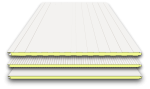
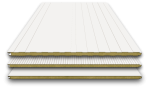
For heated buildings, sandwich panels for roofs and sandwich panels for walls offer an integrated solution consisting of an outer shell, insulation and inner shell.
Comparison table: Material properties
|
Property |
Trapezoidal sheet |
Sandwich panels |
|
Material thickness |
0.5-0.75 mm |
Total 20-200 mm |
|
Weight |
5-8 kg/m² |
8-20 kg/m² |
|
U-value |
5.5 W/m²K |
0.11-0.44 W/m²K |
|
Sound insulation |
Practically none |
Good (absorbent core) |
|
Condensation protection |
No |
Yes (integrated vapour barrier) |
|
Installation time |
Fast (uninsulated) |
Quick |
|
Installation time (insulated) |
Slow (7 layers) |
Fast (3 steps) |
|
Fire behaviour |
A1 (steel) |
B-s1,d0 (PU) to A2 (rock wool) |
|
Material price |
8-15 €/m² |
18-40 €/m² |
|
Total costs (insulated) |
High (post-insulation) |
Moderate |
Sandwich panels cost 2-3 times more in terms of material, but eliminate the need for time-consuming and expensive post-insulation. The total costs for insulated constructions are often lower than for subsequently insulated trapezoidal sheets.
Further technical details can be found in our comprehensive guide to sandwich panels.
All cost figures are rough guidelines and can vary greatly depending on the region, project size and specific requirements. For a precise calculation, we recommend an individual consultation.
Application recommendations according to use
Trapezoidal sheet is ideal for:
- Unheated warehouses
- Agricultural machine halls
- Logistics halls without temperature requirements
- Temporary buildings
- Very tight budgets
- Open roofing (carports, canopies)
Sandwich panels are ideal for
- Heated production halls
- Temperature-controlled warehouses
- Buildings with comfort requirements
- Projects with noise protection requirements
- Blower door tests required
- Limited room height (no reduction through additional insulation)
The choice of material depends primarily on the heating. Unheated = trapezoidal sheet metal economical. Heated = sandwich panels more favourable in the long term despite higher purchase price. Successful reference projects show both solutions in practical use.
Conclusion: The right material for your requirements
Trapezoidal sheet metal is a proven material with clear strengths: economical, lightweight, quick to install, durable with a good coating. For unheated applications - warehouses, agriculture, logistics - it remains the optimum solution.
However, the technical properties also show clear limitations: practically no thermal insulation (U-value 5-6 W/m²K), no sound insulation, condensation problems with temperature differences. For heated buildings, subsequent insulation is unavoidable - at considerable expense and effort.
Sandwich panels offer integrated insulation from the outset (U-value 0.19-0.44 W/m²K), condensation protection and better sound insulation. The higher material price is offset by savings in substructure, installation time and energy costs. They are technically and economically superior for heated applications.
Our recommendation: Choose the material according to its use. Unheated = trapezoidal sheet metal. Heated = sandwich panels. Let us advise you individually on which material is best for your specific requirements.
Last updated Nov 2025