


Trapezoidal sheet corrosion protection: methods, care & permanent solutions
Why corrosion protection is crucial for trapezoidal sheeting Corrosion protection is not a minor matter for trapezoidal sheeting, but is decisive for its entire service life. The thin sheet steel (0.5-0.75 mm) rusts within months without adequate protection. The first signs of rust quickly lead to rusting through - and thus to costly repairs.
This article explains which corrosion protection methods are available, how to choose the right coating for your environment and shows low-maintenance alternatives for extreme corrosion environments.
Why corrosion protection is crucial for trapezoidal sheet metal
The technical properties of trapezoidal sheet metal show the fundamental problem: with a sheet thickness of just 0.5-0.75 mm, the material rusts through within a few months as soon as the protective layer is damaged. Without galvanising and coating, trapezoidal sheeting would become unusable within a season.
Typical weak points:
- Cut edges: Cutting destroys galvanisation - rust after 1-2 years without subsequent treatment
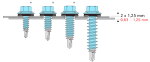
- Screw holes: Water penetrates without proper sealing discs
- Mechanical damage: Any damage to the coating exposes steel
- Condensation: Moisture attacks the coating from the inside
- Contamination: Organic deposits retain moisture
Galvanising and coatings in comparison
Galvanisation classes (Z100, Z140, Z275)
Every trapezoidal sheet is galvanised. The zinc coating determines the protective effect:
|
Class |
Zinc coating |
Application class |
Service life |
|
Z100 |
100 g/m² |
Indoors |
10-15 years |
|
Z140 |
140 g/m² |
Standard Exterior |
15-20 years |
|
Z275 |
275 g/m² |
Coast, industry, agriculture |
25-30 years |
Z275 costs 15-25 % more than Z140, but extends the service life considerably. Galvanising alone is not enough - UV radiation and pollutants attack zinc. Therefore, additional painting is required.
Coatings: Standard polyester, PVDF and plastisol
Painting protects galvanisation from UV radiation and extends the service life. Three quality levels are available:
Standard polyester (25 μm):
- Cheapest option, sufficient for normal environments (C2-C3)
- Service life 20-25 years
- Available in many RAL colours
- Limitations: In coastal, industrial or agricultural applications, often premature failure after 12-18 years
PVDF (35 μm):
- High-quality coating with fluoropolymers
- Better UV resistance, self-cleaning effect
- Service life 30-40 years
- 30-50 % more expensive, but recommended for corrosive environments (C4-C5)
Plastisol (200 μm):
- Thickest coating (8 times thicker than standard)
- Maximum mechanical protection
- Service life 30-40 years
- Mainly for industrial buildings with mechanical loads
|
Coating thickness |
Service life |
Corrosion protection |
Surcharge |
Best application |
|
Standard polyester |
20-25 years |
C2-C3 |
- |
Normal environments |
|
PVDF |
30-40 years |
C4-C5 |
+30-50 % |
Coastal, industry, agriculture |
|
Plastisol |
30-40 years |
C3-C4 |
+40-60 % |
Mechanical load |
Environmental requirements and correct selection
The ISO 12944 standard defines corrosion categories (C1-C5) based on environmental stress:
|
Category |
Environment |
Recommended coating |
|
C2 |
Rural areas |
Z140 + standard polyester |
|
C3 |
City, coast > 10 km |
Z140 + standard polyester or Z275 + PVDF |
|
C4 |
Industry, coast 3-10 km |
Z275 + PVDF |
|
C5 |
Coast < 3 km, chemical industry |
Z275 + PVDF or plastisol |
Near the coast: Salty air is extremely corrosive. At a distance of < 10 km from the sea, Z275 + PVDF is mandatory. Standard polyester fails after 12-15 years.
Agriculture: Ammonia from stables severely corrodes zinc and coatings. Minimum: Z275 + PVDF. Optimal: Sandwich panels for agricultural operations with aluminium or GRP inner shell.
Industrial areas: Air pollutants (SO₂, NOₓ) require Z275 + PVDF. Regular cleaning every 2-3 years extends service life.
Maintenance and economic efficiency
Inspection and minor repairs
Inspection intervals:
- Normal environments (C2-C3): Every 3-5 years
- Corrosive environments (C4-C5): Every 1-2 years
What to look out for: Rust deposits (cut edges, screws), colour changes, soiling, brittle seals, condensation on underside.
Repair minor damage: Remove rust (wire brush), clean surface, apply zinc dust paint, top coat. Costs: €20-50 per spot. Preventive repair is 10-20× cheaper than later restoration.
Re-treat cut edges: Treat with zinc dust paint immediately after each cut on site - otherwise rust after 1-2 years.
Subsequent painting
Coating shows signs of ageing after 15-25 years. Subsequent painting costs 30-50 €/m² (cleaning + primer + 2× top coat + labour time) and extends service life by 5-10 years. Important: Only useful if the galvanisation is intact. Sheet metal that has rusted through over a large area cannot be renovated economically.
Cost comparison over 25 years
Maintenance costs add up. Example 200 m² roof:
Standard polyester: € 2,000 material + € 1,600 inspections + € 2,000 repairs + € 6,000 repainting = € 11,600 over 25 years
PVDF: €3,000 material + €1,000 inspections + €600 repairs = €4,600 over 25 years
High-quality coating saves € 7,000 despite higher purchase price.
All cost figures are rough guidelines and can vary greatly depending on the region, project size and specific requirements. For a precise calculation, we recommend an individual consultation.
Low-maintenance alternative: sandwich panels
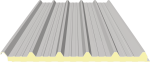
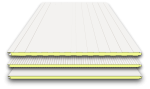
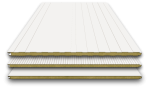
For buildings in extremely corrosive environments, sandwich panels for roofs and sandwich panels for walls offer fundamental advantages:
Double protection: outer shell + PIR insulation core + inner shell. Even if the outer shell shows signs of corrosion damage after decades, the inner shell remains intact. The insulation core acts as a buffer - moisture does not penetrate to the inner shell.
Mechanical protection: The insulation core protects the inner shell from mechanical damage (hail, branches). Outer shell can be damaged - building remains tight.
Low maintenance: Closed system without cut edges, sealed at the factory, no condensation, no corrosion from the inside. Inspection intervals 3-7 years instead of 1-3 years.
Cost-effective for high corrosion requirements:
Example 200 m² roof, near the coast (C4), 30 years:
Trapezoidal sheet PVDF: € 3,000 material + € 8,000 substructure + € 6,000 maintenance + € 6,000 repainting = € 23,000
Sandwich panels 80 mm: € 6,000 material + € 5,000 substructure + € 3,000 installation + € 1,500 maintenance = € 15,500
Savings: € 7,500 over 30 years despite higher material costs.
Further details on the structure and properties of sandwich panels.
All cost figures are rough guidelines and can vary greatly depending on the region, project size and specific requirements. For a precise calculation, we recommend an individual consultation.
Conclusion: The right corrosion protection for your requirements
Normal environments (C2-C3): Z140 + standard polyester offers 20-25 years of service life at a moderate cost.
Corrosive environments (C4-C5): Z275 + PVDF costs 40-50% more, but extends service life to 30-40 years and significantly reduces maintenance. TCO analysis shows: More economical in the long term.
Extreme environments (coastal, agricultural, chemical): Sandwich panels as the better choice. Double corrosion barrier, mechanical protection, low maintenance. Higher initial costs are amortised by drastically reduced maintenance costs.
Our recommendation: Calculate the total costs over the service life, not just the acquisition costs. Seek individual advice on which corrosion protection is best for your requirements.
Last updated Nov 2025