

Trapezoidal sheet metal for the roof: advantages, disadvantages & better alternatives
Trapezoidal sheet metal for roofs is a proven solution for covering industrial, commercial and agricultural buildings. The profiled sheet steel provides reliable protection against the weather and is a convincing solution for large roof areas.
However, modern building requirements now place higher demands on thermal insulation, energy efficiency and installation speed. While trapezoidal sheet has proven properties, sandwich panels for roofs are increasingly becoming a superior alternative for demanding projects.
What is trapezoidal sheet metal for roofs?
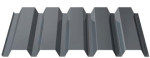
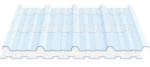
Trapezoidal sheeting consists of cold-formed sheet steel with characteristic trapezoidal profiles. The roof covering is attached to a substructure and forms the weatherproof roof cladding of buildings.
The trapezoidal profile gives the thin sheet (0.5-0.75 mm) the necessary rigidity for large spans. Depending on the profile height, trapezoidal sheets are suitable for everything from small outbuildings to wide-span hall constructions. The galvanised and coated surface enables a service life of 25-35 years.
Main applications: Industrial halls, warehouses, agricultural buildings and canopies. Trapezoidal sheeting is only suitable to a limited extent for residential buildings with strict energy standards, as separate insulation levels are required.
Design and technology
Profile shapes and colours
Trapezoidal sheets are available in various profile heights: low profiles (20-35 mm) for a discreet appearance, medium profiles (35-60 mm) as standard, high profiles (60-200 mm) for maximum load-bearing capacity. Snow load and wind load must be taken into account during planning. You can calculate the required snow load for your project.
RAL colours: RAL 9002 (grey white), RAL 7016 (anthracite grey), RAL 9006 (white aluminium), RAL 3009 (oxide red). The coating quality ranges from polyester standard (25 µm) to polyester HD and PVDF premium (35 µm). An overview of the available RAL colours helps with the design.
Installation and roof structure
Minimum pitch: 5° (8.7 %), recommended 7° (12.3 %) for reliable water drainage. Flat roofs are unsuitable.
Classic roof structure:
- Supporting structure (purlins)
- Thermal insulation (mineral wool/PIR)
- Vapour barrier
- Counter battens (rear ventilation 40 mm)
- Supporting battens
- Trapezoidal sheet metal
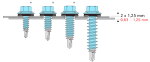
Fastening is carried out using self-drilling screws with EPDM sealant exclusively in the raised beads.
The insulation problem with trapezoidal sheet metal
Trapezoidal sheet metal itself offers practically no thermal insulation. A separate insulation layer is essential for heated buildings. The achievable U-values are 0.18-0.28 W/m²K, but thermal bridges due to fixing points and purlins are unavoidable.
Rear ventilation is essential: A rear ventilation gap of at least 40 mm between the insulation and trapezoidal sheet metal is essential for insulated constructions. It enables moisture removal and temperature equalisation.
The critical weak point: Correct implementation is prone to errors. Insufficient cross-sections, blockages or a lack of air circulation lead to moisture damage that often only becomes visible years later. The multi-layered roof structure requires precise workmanship over several stages.
Maintenance and service life
Modern trapezoidal sheets have several layers of corrosion protection: hot-dip galvanising, primer and top coat. However, cut edges and drill holes are weak points.
Maintenance: Annual visual inspection of screws, seals and coating required. Remove leaves and organic deposits. Repair minor damage immediately. Service life with proper maintenance: 25-35 years.
Advantages and disadvantages of trapezoidal sheet metal
Advantages
✓ Economical: Most cost-effective solution for large areas
✓ Large spans: Production up to 24 metres
✓ Robust against mechanical loads
✓ Available from stock at short notice
Disadvantages
✗ No integrated insulation
✗ Unavoidable thermal bridges
✗ Complex, error-prone rear ventilation
✗ Condensation risk in the event of execution errors
✗ Practically no sound insulation
✗ Complex installation despite supposed simplicity
✗ U-values achieved often do not meet modern energy standards
Modern alternative: sandwich panels for roofs
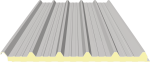
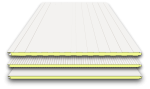
While trapezoidal sheets offer proven properties, sandwich panels are increasingly becoming the superior solution for roofs. Roof panels combine roof covering, thermal insulation and vapour barrier in a single construction element.
Advantages of roof panels
Integrated thermal insulation: U-values of 0.11-0.55 W/m²K without an additional insulation layer. The insulating core made of polyurethane (PU) or polyisocyanurate (PIR) avoids thermal bridges.
Simplified installation: one work step replaces separate installation of vapour barrier, insulation, battens and roof covering. The construction time is reduced by 40-60 %.
Improved airtightness: The tongue and groove system ensures precise joints without time-consuming reworking.
No rear ventilation required: The closed construction prevents moisture ingress. Condensation problems are eliminated.
Maintenance-free: Minimal maintenance required thanks to the closed construction.
Better sound insulation: The insulating core noticeably dampens rain noise.
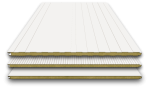
Fire protection: With rock wool core up to fire resistance class EI120, fire protection panels fulfil the highest safety requirements.
Comparison: Trapezoidal sheet metal vs. roof panels
|
Criterion |
Trapezoidal sheet metal |
Roof panels |
|
Installation time |
Several work steps |
One work step |
|
Thermal insulation |
Separate level required |
Integrated |
|
U-value |
Only with additional insulation |
0.11-0.55 W/m²K |
|
Thermal bridges |
Unavoidable |
Minimised |
|
Rear ventilation |
Mandatory |
Not applicable |
|
Maintenance |
Annual |
Maintenance-free |
|
Sound insulation |
Very low |
Significantly better |
|
Fire protection |
Standard |
Up to EI120 |
Application recommendation: Sandwich panels offer clear advantages for commercial buildings, residential buildings and properties with energy standards or fire protection requirements. Further details in our detailed guide to sandwich panels.
Conclusion: Choosing the right roof solution
Trapezoidal sheet metal remains economical for simple industrial buildings and unheated warehouses. However, roof panels are the modern alternative for modern construction projects that demand energy efficiency and speed of installation.
Our recommendation: Let us advise you individually on the best solution for your project. From stock items to customised products, we offer the right system. Successful reference projects demonstrate the versatility of modern roof systems.
Last updated Sept 2026